
For Florida homeowners, choosing a stucco finish is more than a cosmetic decision. A home’s exterior finish influences its architectural character, how visible surface imperfections may be, how repairs blend into the surrounding wall and how the exterior will need to be maintained over time. When comparing smooth vs textured stucco in Florida, however, it is important to separate appearance from the performance of the entire wall system.
A smooth finish is not automatically less durable than a textured finish, and a textured surface does not eliminate the possibility of cracking or moisture problems. Long-term performance depends much more heavily on substrate preparation, plaster application, reinforcement, lath, flashing, drainage, curing and the overall water-management strategy.
In Orlando, applicable permit applications are currently reviewed under the Florida Building Code, 8th Edition (2023) and the corresponding Residential Code. The Florida Residential Code also references ASTM C926 for Portland cement-based plaster and ASTM C1063 for lathing and furring used with exterior plaster systems.
Understanding those fundamentals makes it easier to choose a finish based on architecture and maintenance preferences rather than appearance alone.
What Is a Stucco Finish?
Stucco, technically referred to in building standards as Portland cement-based plaster, is applied as an exterior wall covering over an appropriate substrate and assembly. ASTM C926 establishes requirements for the application of full-thickness Portland cement based plaster, including materials, plaster thickness, environmental conditions, curing and finish-coat application.

The visible surface homeowners ultimately see is the finish coat. That final surface can be worked in different ways to create anything from a nearly flat, contemporary appearance to a visibly textured pattern.Historically, smooth troweled stucco has been used for centuries, while decorative and rougher textures became common across many architectural styles. The National Park Service documents both smooth and rough-textured stucco finishes as established architectural treatments.
For a modern Florida residence, the choice typically comes down to the architectural look desired and how much surface variation the homeowner wants to see.
What Is Smooth Stucco?
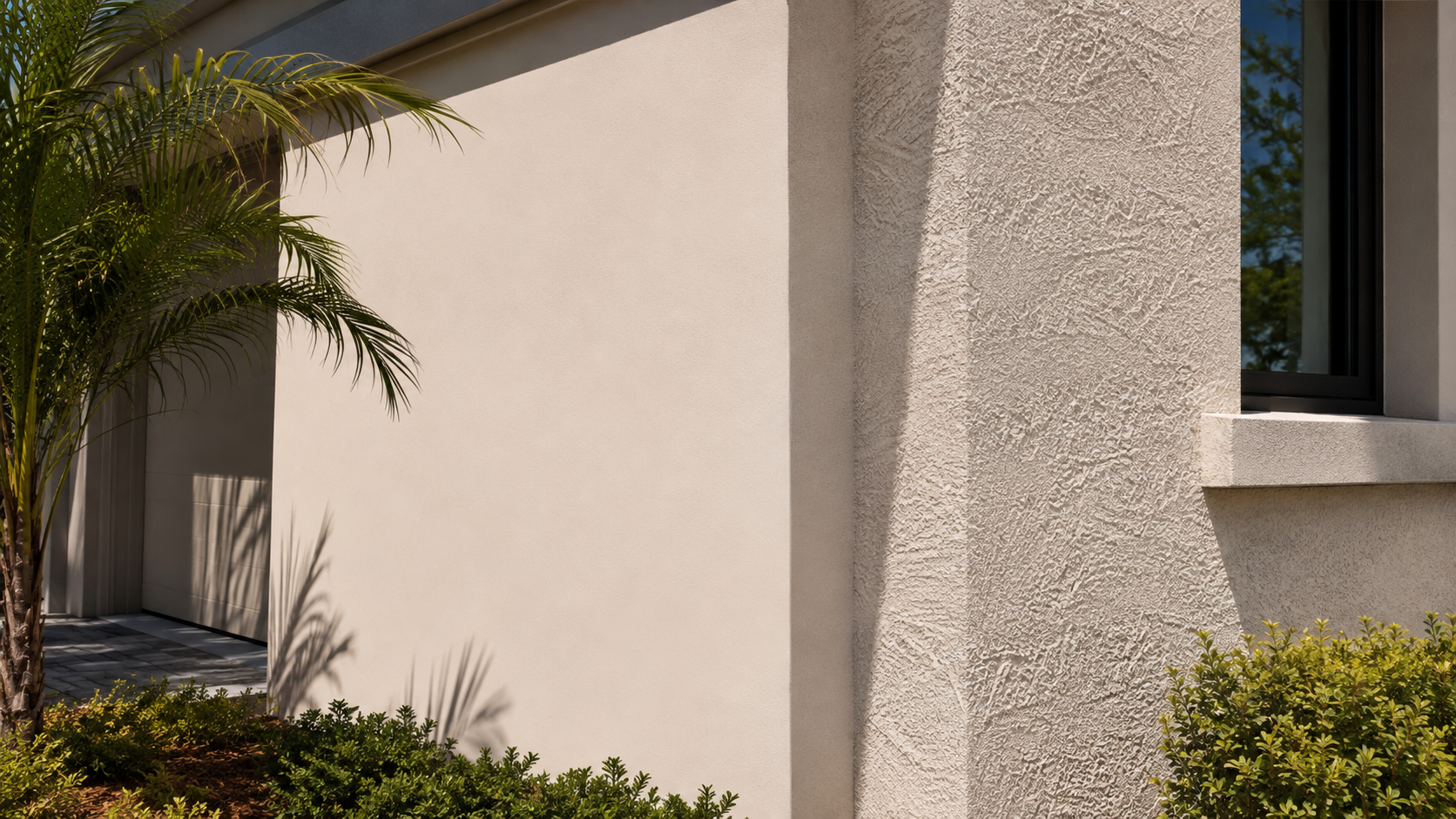
Smooth stucco is finished with a relatively flat, refined surface. Instead of intentionally leaving visible aggregate patterns or raised texture, the applicator works the finish to create a more uniform appearance. This style is particularly compatible with contemporary and luxury architecture because it produces:
clean wall planes, sharp architectural lines and a minimalist appearance. Smooth stucco can work especially well on homes featuring large windows, flat or low-slope rooflines, geometric forms and modern detailing. But the same visual simplicity that makes smooth stucco attractive also means the eye tends to notice surface variation more easily.
Minor waviness, patching, color differences and hairline cracks can become more noticeable on a large smooth wall especially under strong Florida sunlight, which creates shadows across the surface. That does not necessarily mean the finish has failed. It means the appearance is less forgiving.
What Is Textured Stucco?
Textured stucco intentionally introduces visible surface variation into the finish coat.The texture can range from relatively subtle sand or float finishes to more pronounced hand-applied patterns. Because light interacts with an irregular surface differently than with a smooth wall, texture can visually reduce the prominence of small surface variations.
This makes textured finishes popular on many residential developments, Mediterranean-style homes, traditional Florida architecture and large exterior elevations. A textured finish can also make localized aesthetic imperfections less obvious from normal viewing distances. However, this is an important distinction:
Texture can visually disguise minor surface variation, but it does not correct structural movement, improper installation or water intrusion. A crack beneath a textured surface is still a crack. A poorly drained wall remains a moisture-management problem regardless of whether the finish is smooth or textured.
Smooth vs Textured Stucco in Florida: Appearance
The biggest difference between the two options is architectural character.
| Feature | Smooth Stucco | Textured Stucco |
|---|---|---|
| Appearance | Clean, refined, contemporary | More dimensional and traditional |
| Surface variation | Minimal | Intentionally visible |
| Modern architecture | Excellent fit | Depends on texture selected |
| Visibility of imperfections | Generally higher | Can visually mask minor variation |
| Patching visibility | Can be more difficult to blend | Texture can sometimes help disguise repairs |
| Light and shadow | Highlights wall flatness | Creates natural surface shadowing |
For a luxury custom home, smooth stucco often complements a modern architectural vocabulary. For communities with Mediterranean, Spanish-influenced or transitional architecture, textured finishes may feel more consistent with the design. The correct finish should reinforce the architectural intent of the building.
Does Smooth Stucco Crack More Than Textured Stucco?
This is a common misconception. The texture of the finish coat alone is not usually the main reason cracking occurs. Cracks can result from multiple conditions, including:
building movement, shrinkage, substrate movement, improper curing, improper material application, transitions between materials or detailing around openings and control locations. ASTM C926 specifically addresses application and curing considerations related to Portland cement plaster.
The Florida Residential Code references ASTM C926 and C1063 because the performance of the stucco system depends on more than simply the visible finish. What changes with a smooth finish is primarily visibility. A thin crack running across a smooth white wall can be much easier to notice than the same crack passing through a textured surface. That visual difference sometimes creates the impression that smooth stucco cracks more frequently, even when the underlying cause is unrelated to texture.
Why Installation Matters More Than Texture
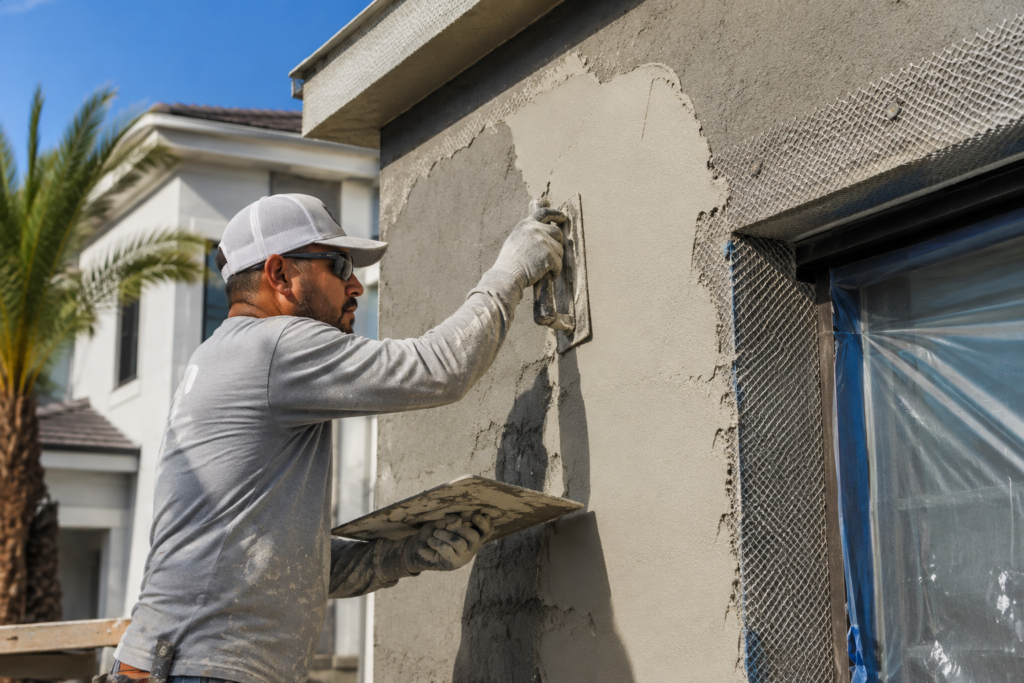
A high quality finish cannot compensate for a poorly executed base system. The plaster must be installed over a suitable substrate using the required materials and detailing. On framed construction, lath and related attachment requirements are an important part of the assembly. ASTM C1063 establishes technical requirements for lathing and furring used to receive Portland cement plaster.
Florida’s residential code references both ASTM C926 and C1063 for exterior plaster systems.The code also addresses components intended to allow trapped water to drain to the exterior, such as weep screeds in applicable wall assemblies. The purpose is significant: stucco should not be treated as the only line of defense against water.
This brings us to one of the most important considerations for homes in Central Florida.
Stucco and Florida’s Hot-Humid Climate
Florida sits within a hot-humid climate region, according to U.S. Department of Energy Building America guidance. That makes water management especially important. DOE research specifically discusses stucco walls in hot-humid climates and notes that stucco assemblies can crack and leak due to installation and weather-related conditions. Its guidance emphasizes treating the wall as a drained assembly rather than assuming the stucco surface alone will stop all water.
That distinction is critical. Whether the home uses smooth or textured stucco, the building envelope still needs appropriate: flashing, water resistive barriers, drainage, window and door detailing, penetrations and transitions between different exterior materials. Heavy Florida rain combined with wind can place significant pressure on those details. A beautiful finish cannot replace proper envelope construction.
Is Textured Stucco Better for Moisture?
Not automatically. Texture changes the outer appearance of the surface, but moisture management depends primarily on the complete wall assembly. Similarly, smooth stucco does not inherently create a moisture problem.
Both finishes can perform successfully when the underlying assembly is properly designed and constructed. DOE’s Building America research highlights drainage and water management as key considerations for stucco walls in Florida’s climate not simply the texture of the final coat. For homeowners, that means asking questions beyond: “Should I choose smooth or textured?”
It is also useful to ask:
How is water directed away from the wall?
How are windows and penetrations flashed?
What drainage provisions are included?
What substrate is being used?
How will transitions between materials be detailed?
Those questions influence long-term performance far more than surface texture alone.
Which Finish Is Easier to Maintain?
Both smooth and textured stucco require inspection and maintenance. Florida homes are exposed to strong sunlight, humidity, rain, landscaping irrigation, airborne dirt and biological growth. The practical maintenance difference is mostly visual.
Smooth finishes make dirt streaks, staining, small cracks and localized patches easier to see because the surface is uniform. Textured finishes can visually hide some irregularities, but deeper texture can also collect dirt in recesses depending on exposure and orientation.
Repair matching can also differ. On smooth stucco, achieving an invisible localized repair can be challenging because changes in flatness, color or trowel technique may remain visible. On textured stucco, matching the existing texture requires skill, but the surface pattern may make small transitions less noticeable.
For either finish, successful repair requires identifying why the damage occurred before simply covering it.That idea will connect directly with our next article:
Signs Your Stucco May Need Repair.
Paint and Color Considerations
Both smooth and textured stucco can be incorporated into a wide variety of exterior color schemes. However, color and lighting interact strongly with texture. Dark colors and low-angle sunlight can emphasize imperfections on smooth surfaces.
Texture creates natural shadows, which can make the same paint color appear slightly different throughout the day. For modern architecture, light neutral colors are commonly paired with smooth surfaces to create clean exterior planes. For more traditional homes, textured finishes often complement warmer or earth-toned palettes. The architectural design should guide the selection rather than choosing texture independently from color.
Smooth Stucco for Custom Homes
For custom homes in Orlando, smooth stucco can create a premium architectural appearance. It works particularly well when the design includes combinations such as: stucco with stone, stucco with architectural metal, large glazing systems, modern entry features or clean geometric wall volumes.
But the higher the visual standard, the more important execution becomes. Large smooth elevations require disciplined preparation and workmanship because subtle irregularities may remain visible once the home is painted and exposed to strong daylight. For a luxury custom residence, the desired finish should therefore be discussed early not after the walls are already prepared.
Textured Stucco for Residential Communities
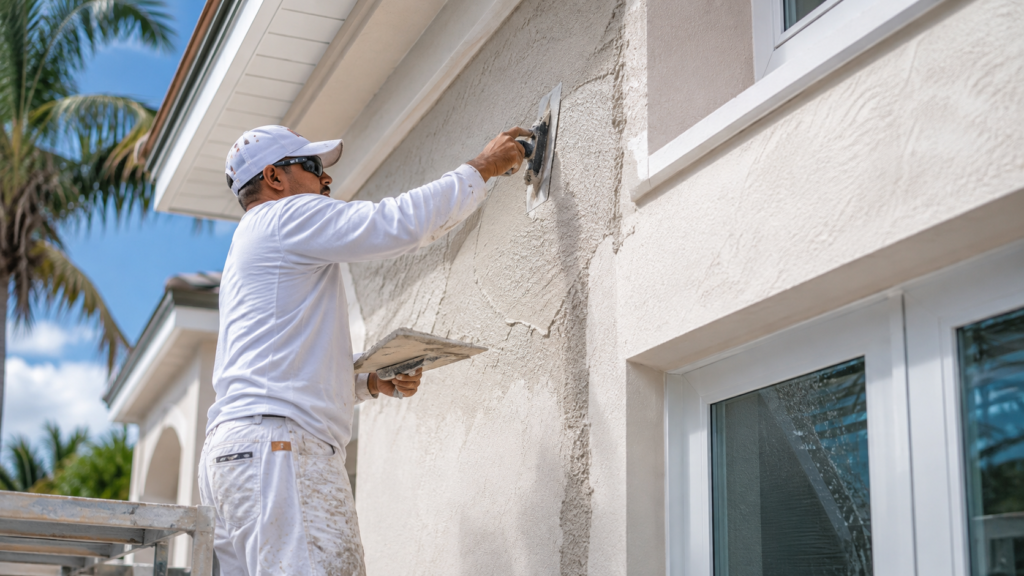
Textured stucco is common in residential construction because it provides architectural flexibility and can be applied consistently across repeated elevations. Different textures can also help distinguish architectural styles within a community while using the same fundamental exterior plaster system.
For townhomes and production residential construction, maintaining consistent texture between buildings, elevations and repair areas becomes an important quality-control consideration. The texture itself should be intentional and repeatable rather than simply used to conceal inconsistent workmanship.
What Should Florida Homeowners Look for?
Regardless of finish type, homeowners should pay attention to the overall condition of the exterior. Hairline cracks may not always represent a serious problem, but cracks that change, widen, recur after repair or appear alongside staining or moisture should receive closer evaluation.
Other warning signs can include:
surface delamination, bulging, persistent discoloration, damaged areas around windows and doors or deterioration near the base of walls. The goal is not to assume every visible imperfection requires major repair. It is to recognize when appearance may be signaling a deeper installation or moisture condition.
We will explore those conditions in detail in the next A7 article on Signs Your Stucco May Need Repair.
Which Is Better: Smooth or Textured Stucco?
For smooth vs textured stucco in Florida, there is no universal winner. Choose smooth stucco when the architectural goal is: a clean, contemporary or luxury appearance with visually refined wall planes.
Choose textured stucco when the project calls for:
greater visual dimension, a more traditional exterior character or a surface that is somewhat more forgiving of minor visual irregularities. But do not select either finish based on the assumption that texture alone determines durability. The more important factors are the substrate, plaster system, reinforcement, detailing, curing, drainage and workmanship.
Final Thoughts on Stucco Finishes in Florida
Stucco remains a widely used exterior finish in Florida’s hothumid climate, but successful performance depends on treating it as part of a complete building-envelope system rather than simply a decorative surface. DOE guidance specifically recognizes stucco’s popularity in Florida while emphasizing drainage and moisture management.
Smooth and textured finishes can both produce excellent results. Smooth stucco creates a refined architectural appearance but tends to make surface variation more visible. Textured stucco provides greater visual depth and can make some minor imperfections less noticeable.In either case, the quality of the underlying installation matters more than texture alone.
For homeowners, builders and developers in Orlando and Central Florida, choosing the right finish means balancing architecture, maintenance expectations, workmanship and building envelope performance.
PLANNING A STUCCO PROJECT IN ORLANDO?
Talk with A7 about professional stucco installation, exterior finishes and specialty construction services for your residential or custom home project.